
PTO-Driven vs. Direct-Drive Fire Pumps: What's the Difference?
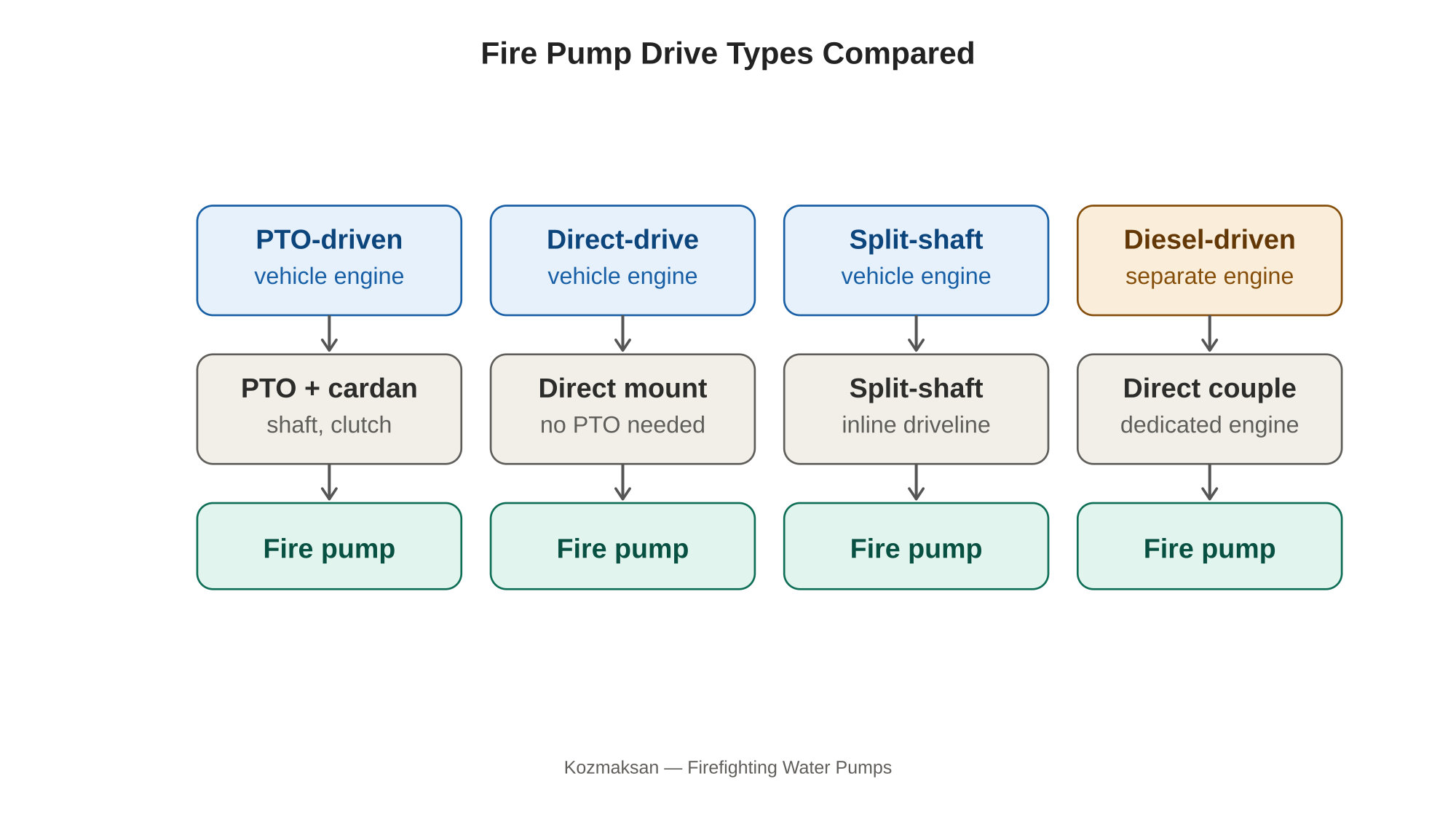
When specifying a firefighting water pump for a fire truck or rescue vehicle, one of the most important decisions has nothing to do with the pump itself — it's how the pump is driven. Different drive configurations affect installation complexity, vehicle compatibility, maintenance needs, and long-term reliability. Here's how the main drive types compare.
PTO-Driven (Power Take-Off) Pumps
A PTO-driven pump takes its power directly from the vehicle's engine through a Power Take-Off unit, typically transmitting rotational power via a cardan shaft and clutch to the pump. This is one of the most common configurations across the fire truck industry, valued for its mechanical simplicity — no separate power source is needed, and the pump operates whenever the vehicle's engine is running and the PTO is engaged.
Advantages: No additional engine to maintain, lower installation weight, straightforward integration with existing drivetrain components.
Considerations: The vehicle's engine must be running to operate the pump, which means "pump-and-roll" operation (pumping while the vehicle is moving) depends on the specific PTO and transmission configuration.
Direct-Drive Pumps
In a direct-drive configuration, the pump is mounted directly to — and driven by — the vehicle's engine, typically at the front or a dedicated drive point, without going through a separate transmission-based PTO. This setup is common on dedicated pumper trucks where the pump is a primary, continuously-used function of the vehicle.
Advantages: Often allows for higher sustained flow rates and simpler power delivery for continuous pumping operations.
Considerations: Generally requires more vehicle-specific engineering and is less flexible for retrofitting onto an existing chassis compared to a PTO-based system.
Split-Shaft Pumps
A split-shaft pump sits in the driveline itself, between the transmission and the rear axle, and can be engaged to divert engine power to the pump while the vehicle is stationary or in pump-and-roll operation. This configuration is widely used on municipal pumper trucks that need reliable pump-and-roll capability.
Advantages: Strong pump-and-roll performance, well-suited to municipal and structural firefighting applications.
Considerations: More complex integration with the vehicle's driveline compared to a standard PTO setup.
Separate Diesel Engine-Driven Pumps
For applications where independence from the vehicle's engine is required — such as portable units or auxiliary systems — the pump can instead be powered by its own dedicated diesel engine, forming a fully self-contained pumping unit. This is common for portable fire pumps and trailer or skid-mounted systems.
Advantages: Fully independent operation, not tied to the host vehicle's engine status; useful for portable or auxiliary applications.
Considerations: Adds a second engine to maintain and fuel, along with additional weight.
Which Drive Type Is Right for Your Application?
The right choice depends on the vehicle platform and the operational role of the pump:
- Retrofitting an existing truck chassis: A PTO-driven system is typically the simplest and most cost-effective integration.
- Dedicated municipal pumper with pump-and-roll needs: Split-shaft or direct-drive configurations are usually preferred.
- Portable or auxiliary pumping needs: A separate diesel engine-driven unit offers full independence from the host vehicle.
Kozmaksan's Approach: PTO Engineering Built In
Because Kozmaksan is a specialist manufacturer of PTOs and cardan shaft drive systems — not only a pump manufacturer — its firefighting water pumps are engineered with the drive system as an integral part of the design, not an added component. Kozmaksan's fire pump range is available in PTO-driven configurations (via cardan shaft and clutch) as well as separate diesel engine-driven configurations, covering 1000 to 3000 L/min capacities with low and high-pressure options.