
Understanding Flow Rate vs. Pressure Trade-offs in Centrifugal Fire Pumps
If you've compared fire pump spec sheets, you may have noticed that the same pump is often rated for different flow rates depending on the pressure — for example, a higher flow rate at a lower pressure, and a lower flow rate at a higher pressure. This isn't a limitation or a marketing trick; it's basic centrifugal pump physics, and understanding it helps you choose the right pump and read spec sheets correctly.
Why Flow and Pressure Trade Off
A centrifugal pump works by spinning an impeller to accelerate water outward, converting rotational energy into flow and pressure. For any given pump, at a fixed rotation speed, there's an inverse relationship between the two: as the pump is asked to produce higher pressure (by restricting outlet flow, such as through a smaller nozzle or higher-pressure application), the flow rate it can sustain decreases. Conversely, at lower pressure with less restriction, the same pump can move a higher volume of water. This relationship is described by the pump's performance curve — a graph every centrifugal pump has, plotting flow rate against achievable pressure.
How the Fire Truck Industry Standardizes This
This isn't unique to any one manufacturer — it's built into how fire pumps are officially rated. NFPA 1901, the U.S. national standard for automotive fire apparatus, requires fire pumps to be rated at multiple pressure points: 100% of rated capacity at 150 psi, 70% of rated capacity at 200 psi, and 50% of rated capacity at 250 psi. In other words, a pump rated for 1,500 gpm at 150 psi is expected to deliver roughly 1,050 gpm at 200 psi and 750 gpm at 250 psi — the same physical pump, performing differently depending on the pressure demanded of it. European normal-pressure and high-pressure combined systems follow the same underlying principle, just expressed in bar and l/min rather than psi and gpm.
Single-Stage vs. Two-Stage: How Manufacturers Approach This Trade-off
Major fire pump manufacturers design around this flow-pressure relationship in different ways. Waterous, one of the longest-established fire pump manufacturers in the industry, explains in its own pump specification guidance that single-stage and two-stage pumps of the same rated capacity are not designed to perform identically: a single-stage pump is optimized to flow large volumes of water efficiently at or near its rated capacity, while a two-stage pump is built to shift between high-flow and high-pressure operation depending on which stage is engaged. Neither design is inherently superior — NFPA 1901 testing treats both equally — but the right choice depends on how the apparatus will actually be used.
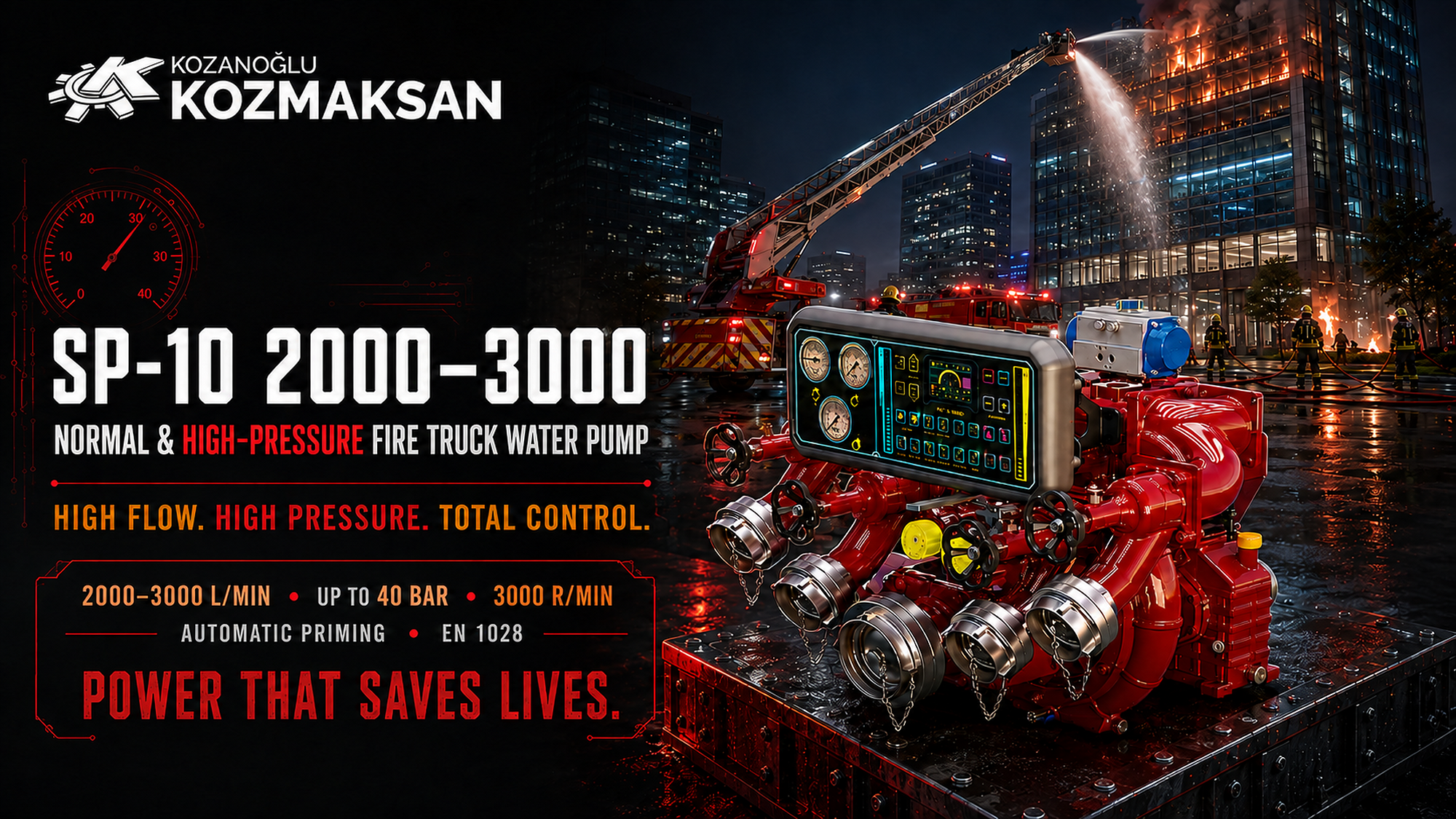
Kozmaksan's range reflects this same engineering distinction. The SP-010-1500 uses a two-stage design suited to fleets that need both efficient high-volume flow and the ability to step up pressure when needed. The SP-10-2000-3000 uses a single-stage design optimized for maximum flow efficiency at its rated capacity — the same design philosophy Waterous recommends for apparatus that frequently operate at or near rated flow.
What This Means When Choosing a Pump
- Higher flow, lower pressure: Best for large-volume water transfer, master streams, and structural firefighting where moving water quickly matters more than pressure.
- Lower flow, higher pressure: Best for booster reels, elevated master streams, or situations requiring greater reach and penetration.
- Reading a spec sheet correctly: A single flow rate number without a matching pressure figure tells you very little — always check both together, and check whether a second (or third) rated point is listed.
Kozmaksan's SP-10-2000-3000: A Practical Example
Kozmaksan's SP-10-2000-3000 demonstrates this trade-off directly within a single pump platform: at 3,000 l/min flow, the pump delivers approximately 10 bar of normal pressure; at the reduced flow rate of 2,000 l/min, the same pump reaches up to 15 bar. This gives fire departments the flexibility to prioritize either maximum volume or higher pressure depending on the incident, without needing two separate pumps. For crews needing even higher pressure for booster reel operations, the SP-10-2000-3000 is also available with an additional 40 bar high-pressure stage delivering 250-400 l/min.
Curious how this compares to normal-pressure-only and combined high-pressure systems generally?
Read our related guide: